How much does property management cost in Bad Homburg?+
HOA management in Bad Homburg typically ranges between €28 and €45 per unit per month in 2026 – above the Hessian average because premium properties require additional effort for heritage-protection coordination, communication with international owners, and upscale grounds maintenance. Special-property management (SEV) for rented units costs a flat €35 to €60 monthly plus a share of new-letting fees. Verto calculates transparently per unit, without hidden flat rates – quotes after a free on-site inspection.
Does the German rent cap (Mietpreisbremse) apply in Bad Homburg?+
Yes. Despite its premium status, Bad Homburg is listed in the Hessian Tenant Protection Ordinance as an area with a tight housing market – the rent cap and reduced cap on rent increases (Kappungsgrenze) apply until 25 November 2026 under the ordinance. The draft successor ordinance of 24 September 2026 provides for a continuation; media report a cabinet decision on 9 November 2026, publication in the official gazette had not been confirmed on 14 November 2026 (as of 14 November 2026). For new lettings, rent may not exceed 10% above the local comparable rent. Existing rents may only rise by a maximum of 15% (instead of the standard 20%) within 3 years. Exceptions: new buildings (first occupied after Oct 1, 2014), comprehensively modernized apartments, and where the previous rent was already higher. Verto reviews the rent cap on every property and drafts legally compliant tenancy agreements.
How much does an apartment cost in Bad Homburg in 2026?+
The average purchase price in 2026 is around €6,250/m² – making Bad Homburg one of the most expensive locations in Hesse, just behind Frankfurt and Kronberg-Schönberg. Top values are reached by Art Nouveau villas around the Kurpark with up to €7,800/m² and premium properties in Dornholzhausen at around €7,200/m². Moderate prices (from approx. €5,000/m²) are found in Ober-Erlenbach and Ober-Eschbach. Prices rose moderately by about 2.1% in 2026 despite the tight market – signaling consolidation after the strong growth years 2020–2023.
What are the average rents in Bad Homburg?+
Net cold rent averages €14.50/m² in 2026. In the city center around the Kurpark, rents reach up to €16.20/m², while Dornholzhausen achieves €15.10/m². Ober-Erlenbach is more affordable at €12.30/m². Rents are rising at about 4.2% per year – well above the Hessian average of 3.1% – driven by strong demand from commuters, Fresenius employees and international executives. However, the rent cap strictly regulates new lettings.
Which districts in Bad Homburg are the most expensive?+
The absolute top location is the city center around the Kurpark and Bad Homburg Castle with square-meter prices up to €7,800/m². Dornholzhausen follows as the second premium district thanks to its spa and thermal-bath tradition (up to €7,200/m²). Kirdorf has established itself as the third most expensive district through new-build projects (up to €6,200/m²). Gonzenheim offers a solid middle-class price level, while Ober-Eschbach and Ober-Erlenbach with rural character and a focus on detached houses cover the more affordable segment.
How does Verto support international owners in Bad Homburg?+
Bad Homburg has a high share of international owners – Fresenius and Hewlett Packard Enterprise executives, Frankfurt bankers, and non-resident capital investors. Verto communicates in German and English, provides bilingual annual statements and economic plans, runs hybrid owners' meetings (in person + Zoom/Teams) once the community has resolved to allow online participation (Section 23(1) sentence 2 WEG), and acts under power of attorney for absent owners. The digital owner portal (Unitflow.pro) offers 24/7 access to all documents – essential for owners who are not permanently in Bad Homburg.
How does the property manager switch work in Bad Homburg?+
A manager change requires a simple-majority resolution in the HOA (§ 26 WEG). After the resolution, a clean handover in Bad Homburg typically takes 3 to 6 months – the time needed for the previous manager's contract to run out, which ends no later than six months after removal (Section 26(3) WEG), the transfer of accounts, files and contracts, and the digital onboarding of all existing data into the new portal. Verto handles the complete handover coordination without additional effort for the advisory board. A detailed guide is available at /en/guides/switching-property-management.
What's special about late-19th-century villas in Bad Homburg?+
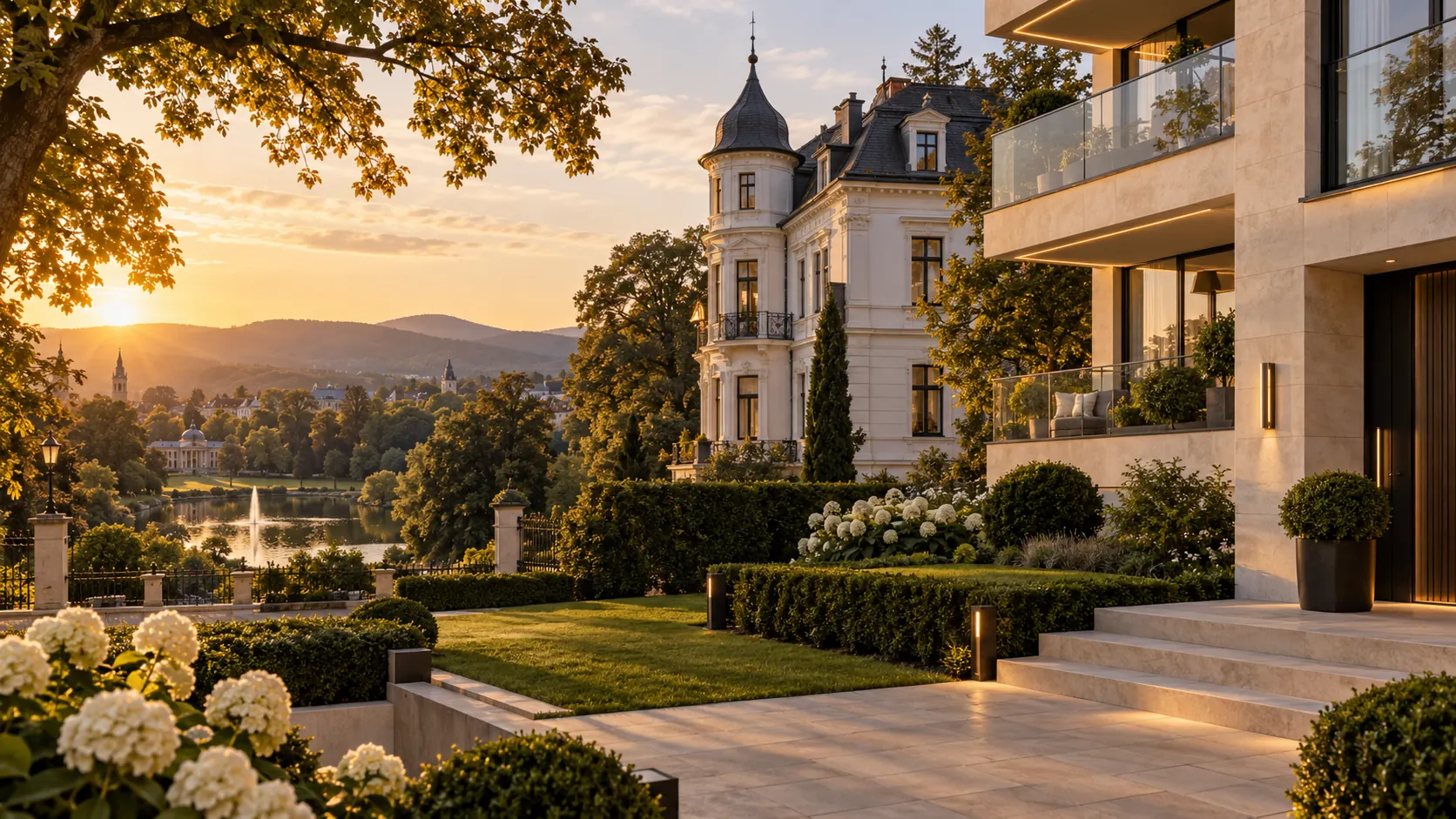
Late-19th-century and Art Nouveau villas around the Kurpark and in Dornholzhausen are mostly heritage-listed. This means: modernization (façade, windows, roof, heating) requires coordination with the Hochtaunuskreis Heritage Office, specialized restoration craftsmen, and longer approval procedures. Energy refurbishment is only partially possible – e.g., interior insulation instead of external thermal insulation systems on historic façades. Verto knows the responsible authority, has contacts to restoration specialists, and accounts for the extra effort cleanly in economic planning.
How is the connection from Bad Homburg to Frankfurt?+
Bad Homburg is connected via the S5 (Friedrichsdorf – Frankfurt Main Station) directly to Frankfurt's main station in 18 minutes. The Taunusbahn complements this towards the Usinger Land area. By car, Frankfurt is reached via the A661/A5 in 20 to 30 minutes depending on traffic. This excellent connection is the central location advantage and makes Bad Homburg the preferred place of residence for Frankfurt's top earners, sustainably supporting the premium rental market.
Who is responsible for HOA disputes in Bad Homburg?+
For HOA decision challenges and proceedings under the WEG (German Condominium Act), Bad Homburg District Court (Audenstraße 1, 61348 Bad Homburg) has jurisdiction. The appellate court is the Frankfurt Regional Court. Verto supports HOAs in legal disputes with qualified property-management lawyers and ensures that meeting resolutions are documented in a legally secure manner – the best dispute prevention. In escalations, we work with specialist WEG lawyers throughout the Rhine-Main region.
Which subsidies exist for energy refurbishment in Bad Homburg?+
Several subsidies stack for energy refurbishment in Bad Homburg: KfW programs 261/262 (residential building loans), BAFA grants for heating replacement and individual measures, and the Hessian "Modernization within existing stock" program. For heritage-listed properties in the Innenstadt and Dornholzhausen, increased special depreciation under § 7i EStG applies. Verto prepares HOA resolutions, obtains comparable quotes, and coordinates with energy consultants and the heritage office.
How does Verto handle out-of-hours emergencies in Bad Homburg?+
Verto operates a 24/7 emergency system with dedicated craftsman partners across the Hochtaunuskreis district. For water ingress, heating failures, or electrical issues, owners and the advisory board reach a hotline that dispatches a first-response order within 30 to 60 minutes. Local partners from Bad Homburg and Friedrichsdorf typically arrive within 1 to 2 hours. Complete process documentation runs live through the digital owner portal.
Which insurance policies are essential for an HOA in Bad Homburg?+
A Bad Homburg HOA needs: residential building insurance (fire, water damage, storm/hail, optionally elemental damage) and property owner's liability (Section 19(2) no. 3 WEG); the manager must provide proof of his own pecuniary loss liability insurance himself (Section 34c(2) no. 3 GewO). For premium Kurpark properties, increased coverage for heritage substance is advisable – including glass and decorative-glass coverage. Verto reviews insurance at mandate start, obtains comparison quotes, and adjusts coverage amounts annually to current market prices.
How does HOA management at the Kurpark differ from a standard apartment building?+
Kurpark properties require additional competencies: heritage coordination for façades, windows, and roofs; specialized restoration craftsmen (e.g., for historic plaster ceilings or wooden windows); elevated maintenance of outdoor areas (historic gardens, fountains); resolutions on structural changes, which in addition to a simple majority (Sections 20(1) and 25(1) WEG) often need a permit under heritage law; and communication at a premium level with demanding owners. Per-unit management costs are therefore 20–40% above standard properties – in return, the substance value is sustainably secured.