Commercial management
- Leases, indexation and deadlines
- Rent payments and arrears
- Operating costs per tenancy
- Owner approval for larger contracts
Verto property management
Offices, practices, halls and mixed-use buildings need both contractual and technical oversight. Our property managers work directly with our in-house technical team.
Definition
Commercial property management combines three tasks. On the commercial side it runs leases, indexation, service charges and owner reporting. On the technical side it takes on operator duties, statutory inspections, maintenance and warranty claims on new buildings. On the facility side it manages cleaning, caretaking, security and grounds. The individual lease governs almost everything, because German commercial tenancy law has few mandatory protections.
We manage office buildings, medical centres, factory and logistics halls, fire stations with residential units and mixed-use buildings across the Rhine-Main region. Every property is looked after by at least two property managers certified under § 26a WEG, more for large properties, supported by our in-house technical team and in-house property accounting.
What we take care of
We agree the scope for your property in writing. Ongoing management and separately commissioned work are clearly distinguished in the proposal.
Request a proposalFrom our work
Selected project profiles from our portfolio, available in German.
3.600 m²Bürofläche
01 / Wiesbaden
3.600 m² Bürofläche und eine Gewerbehalle in kaufmännischer und technischer Betreuung.
10Arztpraxen
02 / Frankfurt am Main
WEG-Verwaltung und technische Betreuung eines Frankfurter Ärztehauses. Geplant sind der Ersatz beider Aufzüge und weitere größere Sanierungen.
ca. 25Wohneinheiten, zusätzlich eine Feuerwache
03 / Frankfurt am Main
Erstverwaltung nach Übernahme von der ABG Holding. Rund 25 Wohnungen und eine große Feuerwache.
The people responsible
Your property managers work directly with our specialists in Eschborn. Building issues and accounting questions have named people responsible for them.
Meet the team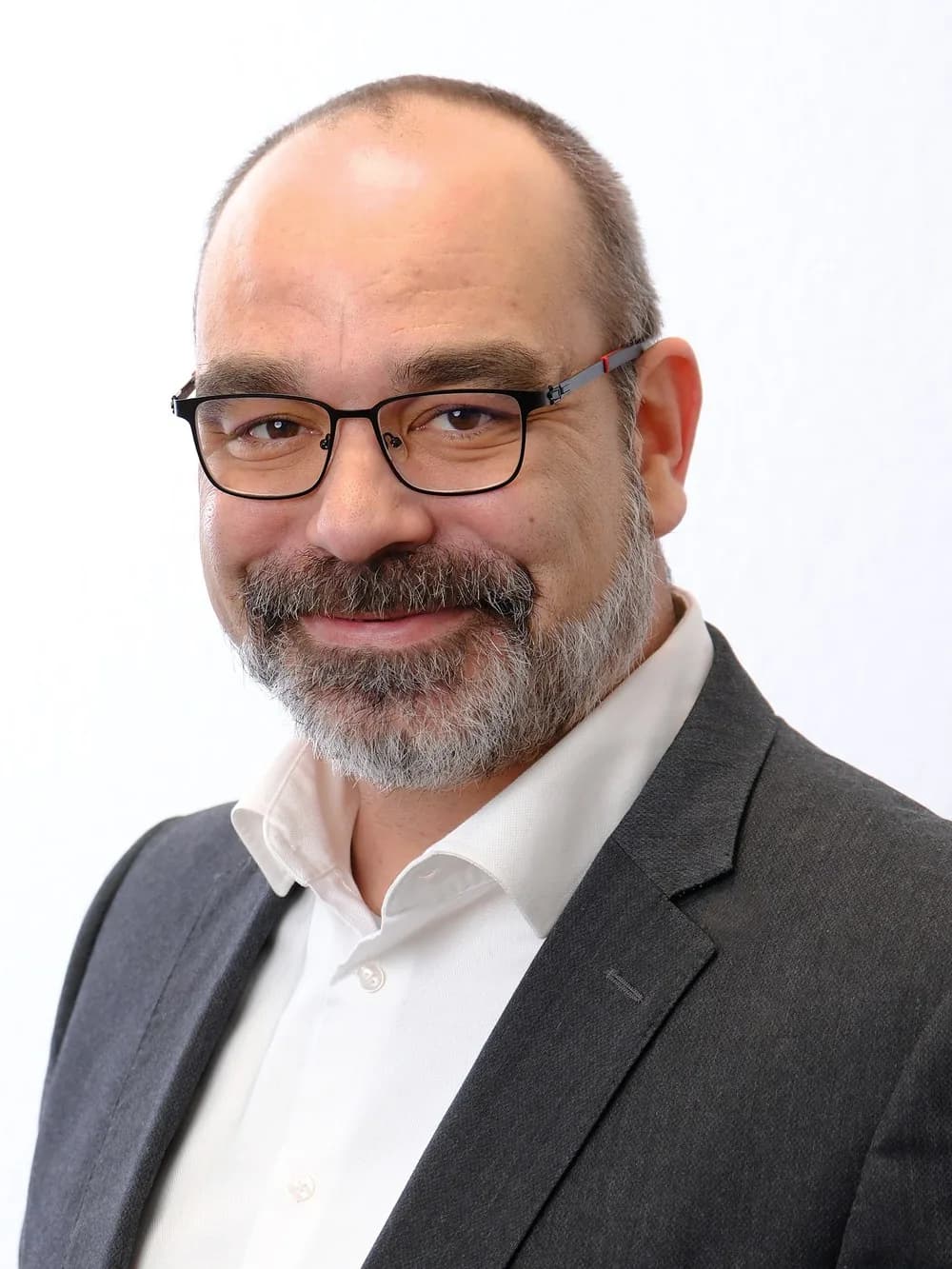
Head of technical property management
Over 20 years in property and facility management. Previously responsible for operations at the ECB towers in Frankfurt.

Head of property accounting
More than 30 years in property accounting. Responsible for annual accounts, budgets and operating costs.
The handover
We agree the date and scope with you. A review of the records establishes what needs to be carried forward.
We get to know the property and prepare a proposal.
We assign your contacts and request the relevant documents.
We reconcile records and accounts and organise ongoing matters.
Commercial management
In commercial letting, freedom of contract largely applies. Which costs the tenant bears, how the rent is adjusted and which options can be exercised is set out in the lease and its addenda. When we take over a property we read every lease in full and enter terms, renewal options, notice periods, indexation dates and special rights into a deadline register, each with an owner and a lead time.
Many commercial rents are linked to the German consumer price index. Under the Price Clause Act, an automatic index clause is permitted if the lease runs for at least ten years or the tenant can extend it to that length. We check the clause, calculate the adjustment on the agreed date and notify the tenant with a transparent calculation.
For leases longer than one year, § 550 BGB (applied to commercial premises through § 578 BGB) sets a form requirement. If it is not met, the lease is treated as concluded for an indefinite period and can be terminated with statutory notice. Since the 2025 reform, text form is sufficient for commercial premises. We still make sure every addendum is complete and clearly refers to the original lease.
The German Operating Costs Ordinance (BetrKV) applies only to residential tenancies. A commercial lease can pass on further costs, such as management fees, upkeep of common areas or certain insurance premiums, provided it names them clearly. We bill exactly what each lease allows, using the agreed allocation key. Deposits are not capped at three months' rent as they are for flats, so we also monitor bank guarantees for amount and expiry.
Technical management
The owner of a commercial building is responsible for the safety of its installations and the grounds. That responsibility stays with the owner, but its execution can be delegated to a carefully selected and supervised manager. We take on this role under a written agreement that defines which installations we run and which remain with tenants, for example in tenant fit-outs.
Every safety-relevant installation has its own inspection requirements and intervals. We record each one with location, last inspection and next due date, instruct the expert or maintenance contractor and file the report in the owner portal. Defects found get a deadline and are tracked until resolved.
From the initial survey we build a multi-year maintenance plan covering roof, facade, building services, lifts and external areas, with condition, priority and budget. Larger works are tendered, supervised and accepted by our technical team.
Warranty management
Pursuing warranty claims on new buildings and major refurbishments is one of our core strengths. Acceptance starts the limitation period and shifts the burden of proof for defects to the client. Under § 634a BGB, claims for defects in a building become time-barred five years after acceptance. Where the VOB/B is validly agreed, the period is four years. For maintenance-sensitive parts of mechanical and electrical installations it is two years under the VOB/B if maintenance was not awarded to the contractor.
Known defects must be reserved at acceptance, otherwise rights are lost. We attend acceptance with our technical team, record every reservation and build a deadline calendar per trade and contractor. Well before each period expires we inspect the building, document every defect with photos and location and give written notice to the responsible contractor.
Under § 13(5) VOB/B, a written request to remedy a defect starts a new two-year period for that defect, ending no earlier than the original period. Under a contract governed only by the BGB, a notice of defect alone does not suspend limitation, so we agree further steps with the owner's lawyer in good time. Guarantees and retentions are released only when nothing remains open.
Mixed-use properties
Many Rhine-Main buildings combine both uses: shops, practices or restaurants on the ground floor with flats above, or a special-purpose building with a residential share. Residential tenancy law and the BetrKV apply to the flats, the individual lease to the commercial units. We keep both separate in billing and in the deadline register, with one main contact for the whole building.
One example is a new building in Frankfurt's Schwälmer Straße that we took over as first manager: around 25 flats and a large fire station within one owners' association, with full defect tracking for common and individual property. Another is a medical centre in Frankfurt with ten practices, where we are preparing the replacement of both lifts around ongoing patient traffic.
Service charge billing shows the difference most clearly. Residential tenants may only be charged costs listed in the BetrKV, and they must not carry costs caused by the commercial units. If a restaurant uses far more water or waste capacity than the flats, the costs need a pre-deduction or separate metering. We set up this split when we take over and document it, so every statement can be traced back to its basis.
Tenants and space
Every handover and return of space is recorded with meter readings, keys and photos. The condition at move-in is the basis for any later discussion about reinstatement. Fit-outs often affect fire safety, structure, escape routes and building services, so our technical team reviews plans before the owner gives consent. We reply to enquiries within 24 hours.
When a tenant gives notice or a lease approaches expiry, we start months ahead. We check renewal options and their deadlines and prepare a decision paper for you covering the market, any investment the space needs and the effect on service charges and vacancy risk. Vacant space stays in the inspection schedule, and heating and water systems are run so that no consequential damage occurs.
Where space is vacant, our in-house brokerage team can market offices, practices, retail units and halls and negotiate the lease. The same management team then runs the new lease, so handover, fit-out and deadlines continue without a break.
Reporting and team
Private owners, funds and family offices need different reports, so we agree frequency, depth and format at the start. A typical monthly or quarterly report shows rent received, arrears, budget versus actual, ongoing works and upcoming deadlines. The property account and all documents are available in the portal at any time. Fees are calculated per property after a site visit and a review of the leases, with separately commissioned services listed in writing.
Every commercial property is managed by at least two property managers certified under § 26a WEG, more for large properties, together with our technical team and in-house accounting. Benjamin Böcker, Head of Technical Property Management, previously ran the technical and commercial operation of the three ECB towers in Frankfurt (around 300,000 m²) as area head, and before that the four DZ BANK towers as technical head. Property accounting is led by Ralf Hennig, a business economist with more than thirty years in property accounting. Our office is at Mühlstraße 36 in Eschborn, minutes from Frankfurt.
Questions and answers
Office buildings and towers, medical centres, factory and logistics halls, fire stations with residential units, mixed-use buildings and owners' associations with office and retail units, as well as new buildings in their warranty phase. Smaller commercial units within residential schemes are covered by our HOA or rental management.
Under § 634a BGB, claims for building defects become time-barred five years after acceptance. Where the VOB/B is validly agreed, the period is four years, and two years for maintenance-sensitive parts of mechanical and electrical installations if maintenance was not awarded to the contractor. The individual contract always decides.
Under VOB/B contracts, a written request to remedy a defect starts a new two-year limitation period for that defect, ending no earlier than the original period. We therefore give notice in writing with proof of delivery.
No. The BetrKV applies only to residential tenancies. For commercial premises the lease decides which costs are passed on, which can include management fees or upkeep of common areas if clearly stated. We bill each tenant exactly according to their lease.
Typically recurring inspections of lifts, fire alarm, sprinkler and smoke extraction systems, ventilation systems under VDI 6022, fixed electrical installations under DGUV Regulation 3 and, where applicable, the drinking water system. Special-purpose buildings require additional inspections under state building law. We keep all dates in one register and file the reports in the portal.
At least two property managers certified under § 26a WEG, more for large properties, plus our in-house technical team and property accounting. Technical property management is led by Benjamin Böcker, formerly area head for the operation of the three ECB towers in Frankfurt.
We price each commercial property individually, based on floor space, uses, number of tenants and technical scope. After a site visit and a review of the leases you receive a written proposal that lists separately commissioned services, such as site supervision for major works.
Yes, through our in-house brokerage team. It markets offices, practices, retail units and halls and negotiates the lease, which the same management team then runs.
Your next step
Tell us where your property is and what you need. We will discuss the scope of service and the next steps with you.